
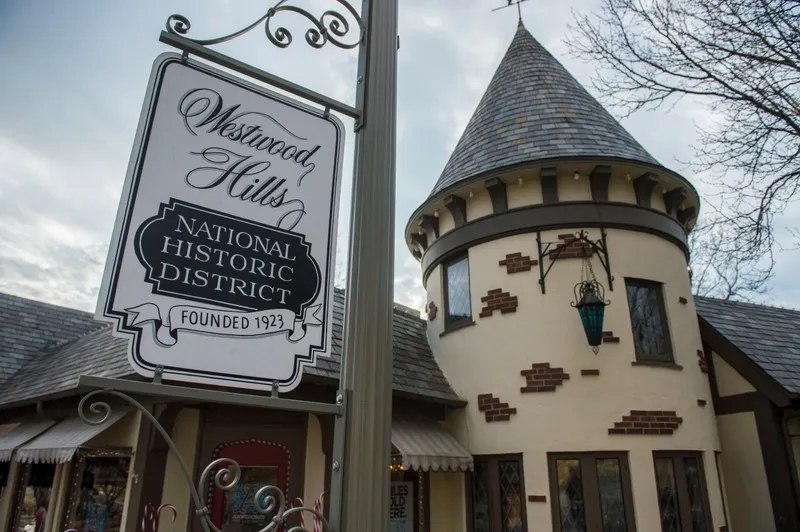
Westwood Hills has kept its 1920s character, and the garage door is a bigger part of that than most people realize.
A planned neighborhood from the 1920s
Westwood Hills is one of the smallest municipalities in the metro and one of the most architecturally intact — a 1920s planned neighborhood of curving streets, mature trees and Tudor and colonial homes that have largely kept their original character. That character is the whole point here, and a garage door is a large visible part of it.
We treat replacements in Westwood Hills as an architectural decision first and a mechanical one second. Carriage-house styling with overlay stiles, a divided-light top section, and hardware that reads as period-correct suits these homes. Insulated steel with a woodgrain finish gets you the look of the original wood door with none of the swelling, repainting or weight. Flat contemporary panels are the wrong answer on nearly every street here.
What the old garages need mechanically
Detached garages, narrow openings, low headroom and framing that has settled over a hundred years — the same profile as neighboring Westwood, and the same approach. Measure the opening as it actually sits, shim rather than force, and expect that nothing is square.
Where an original wood door is still in service and worth keeping, we can keep it running. Wood absorbs moisture and gains weight over decades, so the spring has to match the door as it weighs today, not as it left the factory. We weigh it. A properly sprung wood door lifts with one hand.
Working in a small neighborhood
Streets are narrow and driveways are short. We stage carefully, keep the work area clean, and haul the old door and hardware away with us rather than leaving it at the curb.
Getting to you
About twenty minutes from the shop.
